How Total Fishing grew revenue 70% while cutting ad budgets.
Total Fishing is one of the premier fishing-tackle retailers in its market, running online and brick-and-mortar operations with 70,000+ active products — and acquisition costs that were climbing out of control.
The market headwinds
Three forces converged and made the old approach impossible to sustain.
Exploding CPCs
Google Ads CPCs on Shopping and PMax rose 61% year over year, lifting baseline acquisition cost across the entire catalog.
An aggressive new competitor
A major international player entered the market, rapidly captured top-3 impression share, and forced a bidding war.
Shrinking budgets
Heading into Q4, ad budgets were cut 30% on Google and 17% on Meta — while the target non-brand ROAS stayed at 5.0×.
The strategy: eliminate the Black Holes
Spend less by refusing to fund the products that never pay it back — surgically, not by pausing campaigns.
Segment the whole catalog
PMK Core joined sales data with ad spend across the 70,000+ product feed and segmented every SKU. The finding: a mass of Black Holes — products consuming 42% of the Google Ads budget while generating zero revenue.
Step 2Exclude surgically, via the feed
Instead of pausing campaigns, PMK Core's supplemental feeds automatically excluded Black Holes from the main PMax and Meta campaigns. Budget flowed to viable products, and over 90% of campaigns saw immediate ROAS improvements.
Step 3Quarantine, don't delete
The excluded products weren't thrown away. They moved into a restricted parallel campaign with a strict ROAS target and a 5% budget cap — forcing the algorithm to bid efficiently instead of spending blindly.
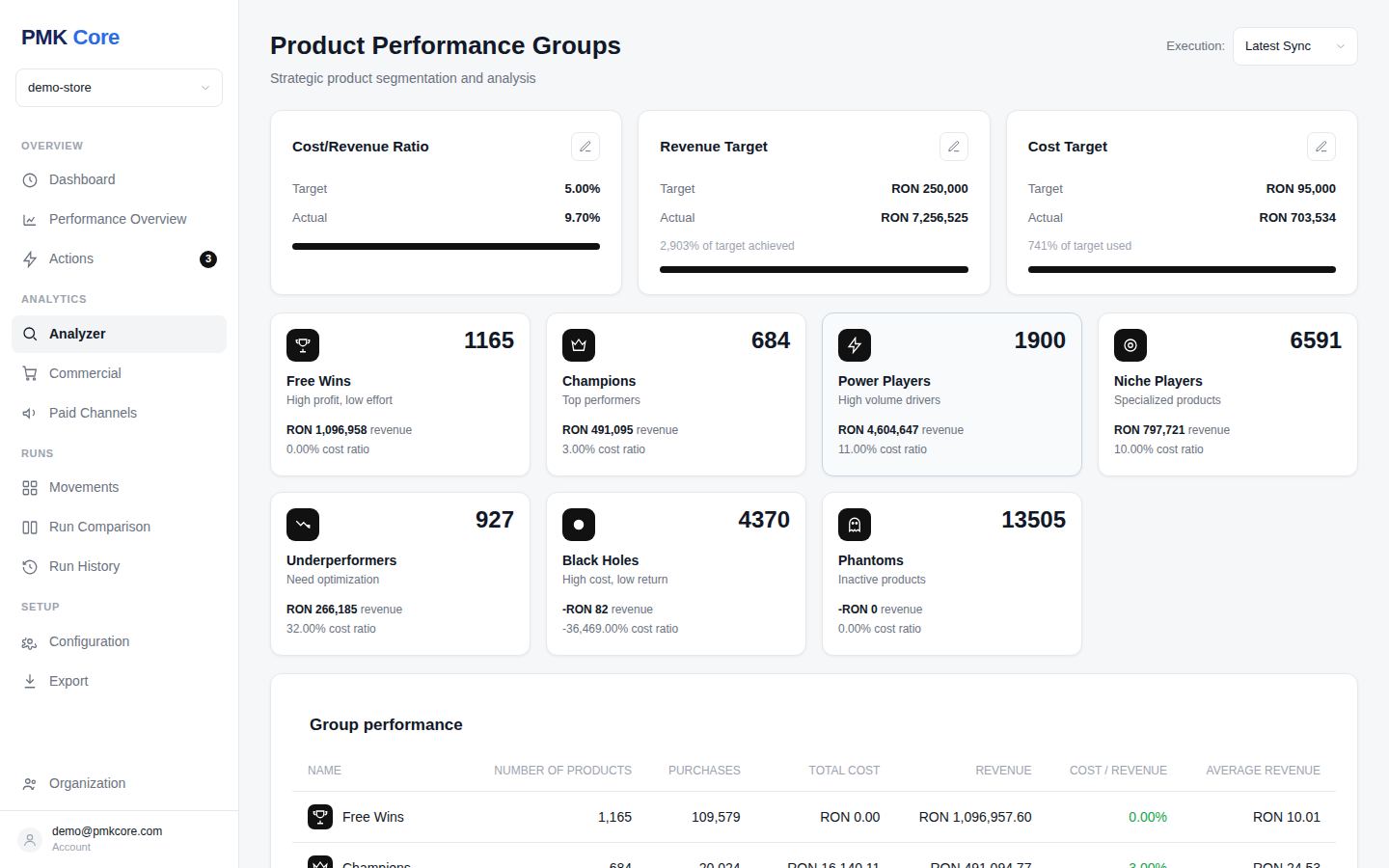
The segment engine behind the strategy — every product lands in one of seven segments, every run.
The financial impact
Waste eradicated
Wasted spend on Black Holes fell from 42% to 14% on Google — and to 0% on Meta.
Revenue up against the wind
+21% Google Ads revenue and +70% Meta revenue — achieved despite platform CPCs running 43% higher.
Peak season, smaller budget
On Black Friday, with significantly lower total ad investment, revenue still grew +28% year over year — by spending only on Champions and Power Players.